
AI is everywhere. Everyone is talking about it, from the silliest memes to the most important scientific breakthroughs. It is touching every sphere of human life, and through us, the whole planet. Some people are thrilled by it, with the kind of excitement no performance-enhancing drug could produce (yes, Jensen Huang, I am looking at you). Others are bracing for the doom this new intelligence is supposedly going to usher in. But let us step back and look at artificial intelligence from a distance, detached from our own interests, because otherwise our biases will inevitably creep in.
Life has been evolving on this Earth for billions of years, from the single-celled amoeba to that most sophisticated ensemble of organic cells, the human being. The planet has come a long way. Billions of years of research and development have delivered us to a moment where we are talking about artificial intelligence. Yet if you trace humanity’s journey on this planet, none of this should come as a surprise. Artificial intelligence, or superintelligence, or whatever you choose to call it, is the natural outcome of human evolution. And I do not mean physical evolution. I mean the evolution of the dominant forces through which humans have exercised their agency on the planet.
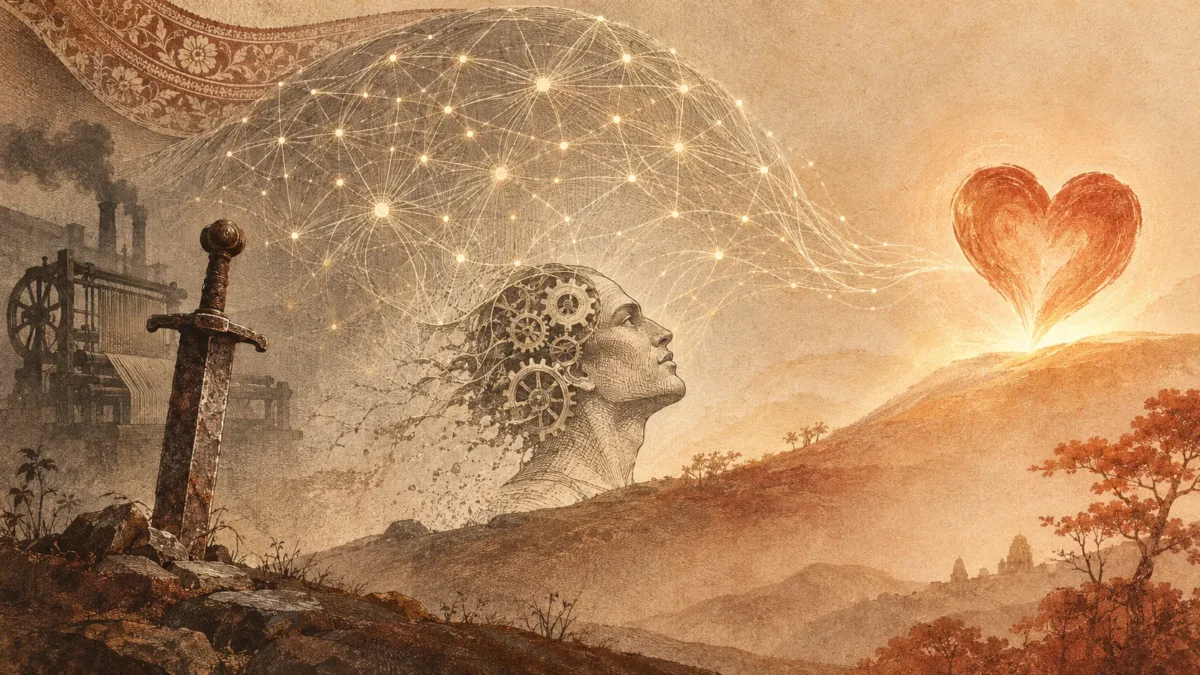
Before the Industrial Revolution, physical strength was the most dominant human force. Warriors ruled the world; they made the decisions that shaped the lives of the majority. Physical strength was the most fully expressed human faculty. Then came the machines, and they made that strength obsolete. A brawny man with a sword was nothing in front of a slight man with a gun. And so that aspect of humanity began to recede, overtaken by human thought. Physical strength stopped ruling the world and retreated into sport and entertainment. Brain took over from brawn; human intelligence took centre stage in shaping human lives. Of course, the transition was not peaceful. In the early nineteenth century, English weavers who saw their livelihoods threatened by mechanised looms broke into factories at night and smashed the machines with hammers. History remembers them as the Luddites. They were not wrong about what they were losing; they were only wrong to think they could stop it.
In India, the irony ran the other way: there it was the British who crushed the thumbs of the weavers, so that human hands could never again compete with their machines.
Now, with artificial general intelligence on the horizon, the world is ready for yet another transition. AI is making our brainpower obsolete. Human thought is beginning to look puny beside what AI can do, and the time is coming when people with big brains will be replaced, because however much you have read, it counts for little against a machine that has read everything. Just as the gun erased the difference in strength between two men, AI is erasing the difference in learning between two minds: a high schooler with the right tool can now stand toe to toe with a PhD. Human thought and intellectual prowess will be outsourced to AI. Some people are protesting, but they are the intellectual heirs of the Luddites, swinging their hammers at a future that has already arrived. The looms won then, and the machines will win again.
But what will replace human thought?
Brain replaced brawn, but what will replace the brain?
Look closely at what is happening and you will see a clear pattern: humanity is moving from the grosser manifestations of its expression to the subtler ones. Extrapolate that trajectory, and we arrive at human emotion, subtler still, and the next paradigm in the evolution of human expression on this planet. AI will bring human emotion to the forefront, to the centre stage of the world. Emotion will become the most valuable and sought-after currency in the age of AI. Love will finally get the place it has always deserved. People in love have always known its value, but as a society we have never appreciated love the way we will in the coming decades. And not just love: the whole spectrum of human emotion will find its most outward expression. That will create its own set of problems, but perhaps, for the first time in history, the economy will no longer be the driving force on the planet. Money may finally find its rightful place: in our pockets, rather than in our minds.
And what will the human mind do once it has been replaced? It will either go insane or become a tool for self-enquiry, because that is the one thing AI cannot do for us, however powerful it becomes.
Write your response