
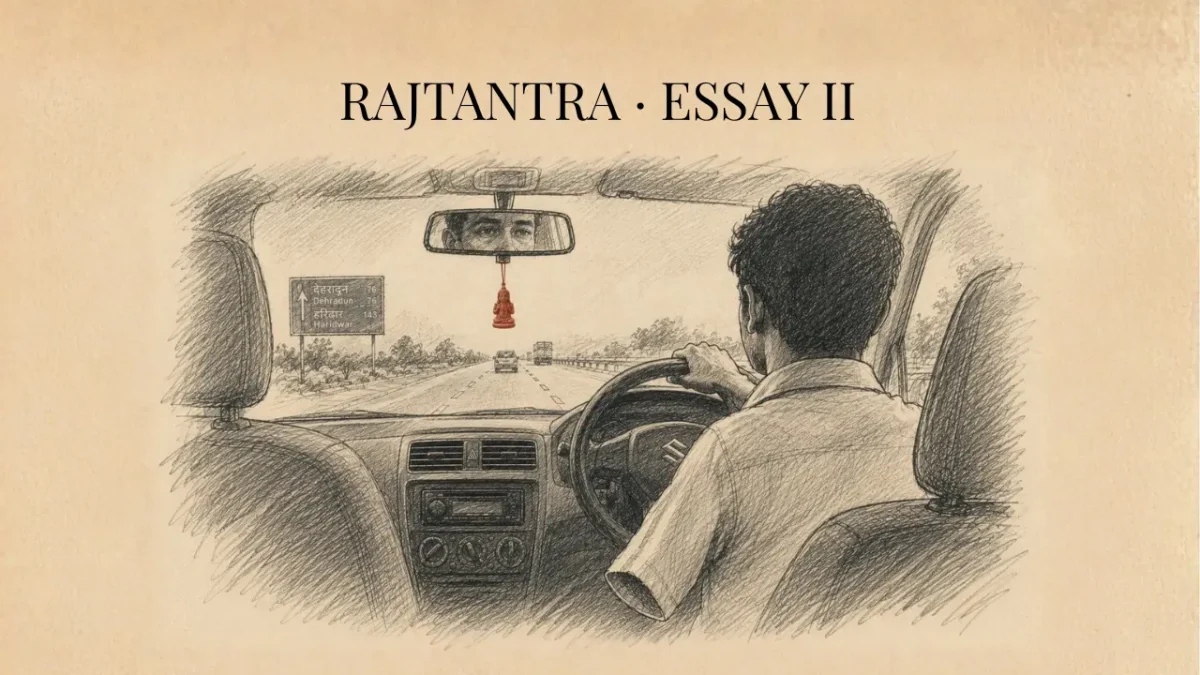
I had to travel from Delhi to Dehradun on a rush day. The trains were full, so I booked an intercity cab. I don’t mind this, truth be told; I have never much liked train travel. A train seals you off from everything that lies between you and your destination. I still remember my first sleeper journey: I fell asleep in Dehradun and woke up in Delhi, and felt cheated, as if the journey had never happened at all. The new highways, for all their smoothness, are doing something similar now, turning travel into a monotonous blur. This is not an argument against highways. It is only a confession that I like to meet whatever comes between me and where I am going.
On this journey, what came in between was a story I have not been able to put down since.
Somewhere past the halfway mark, I noticed from the back seat that the driver was steering with one hand. At first I assumed he was on his phone, and paid no attention. But kilometre after kilometre, the second hand never appeared. As we neared Dehradun, my irritation got the better of my politeness and I confronted him about using his mobile while driving.
He was not using a mobile. He was driving with one hand because one hand is all he has.
I asked. And he told me, eyes on the road, voice level, the way a man gives directions to a place he has been too many times. On a night duty some years ago, a booking came from an isolated stretch of roadside. Three or four men got in. He asked for the OTP. Just drive, they said, the OTP will come. He refused. From behind his seat, a cloth soaked in something chemical was clamped over his mouth and nose, and that is where his memory stops.
It resumes in an abandoned place, in his own car, with a left arm so badly destroyed that the hospital his family rushed him to could only take it off.
He told me the plan, as he later pieced it together, in the same flat voice: they had wanted the car, which meant getting rid of the driver. Somewhere a border could not be crossed, so they abandoned both: the car, and him inside it, left to die. He said this without raising his tone even half a note, and I remember realising, somewhere around Roorkee, that his calm was the most frightening thing in the car. This is what it sounds like when a man has told a story fifty times to people paid to listen and been heard by none of them. The story has stopped expecting anything from its listener. It has been worn smooth, like a stone.
Up to this point, this is a crime story, and crime exists in every society; it would be foolish to imagine one without it. What follows is not a crime story. It is the story of our police system.
Because here is the thing: he knew who did it. The booking had come from a phone number; his daughter later called it, and one of the men from that night answered. He knew the name. He knew the town. In any functioning system this case was three-quarters solved before a single policeman lifted a finger. Instead, the police made him orbit the paperwork. And whenever he appeared at the station, a thin man with one sleeve folded, holding his documents in his remaining hand, he would hear it from across the room, not even whispered: “Are yaar, ye lulla phir aa gaya.” Here comes the cripple again. A man who had lost his arm to attempted murder was reduced to a station-house joke.
The lawyer he could barely afford switched sides. And most damning of all: no FIR was ever registered. He pleaded: forget the criminals, just write the FIR so I can claim my insurance. Even that was denied. It is the one place his flatness cracked, just slightly, a small drop in the voice on the word insurance: not justice, not vengeance, a man begging the state for a piece of paper. When a station refuses an FIR in a case where the victim has handed them the culprit’s name and phone number, it is not incompetence. It is complicity.
Lalita Kumari v. State of U.P. (2013): a Constitution Bench of the Supreme Court held that registration of an FIR is mandatory for every cognizable offence. The police have no discretion to refuse.
After exhausting every door a poor man can knock on, he did what millions in this country quietly do: he stopped. He has a school-going daughter and a son. So he went back to driving a taxi, one-handed, having given an arm to the criminals and his faith to the state. And I sat behind him for two hundred kilometres before I even noticed.
The First Emotion Is Fear
Ask yourself what is the first emotion you feel when you see a policeman. I can answer for most of us: fear. And in that answer lies the entire disease.
A police force exists so that citizens feel secure; ours makes citizens feel watched.
This is not an accident of bad recruitment. It is inheritance. The Indian police still functions under the skeleton of the Police Act of 1861, a law the British wrote in the shadow of 1857 with one purpose: to control a suspect population, not to serve a free one. The ruler-subject relationship was hard-coded into the thana, and it has outlived the ruler. Surveys like the Status of Policing in India Report keep confirming what we all know from experience: large sections of Indians hesitate to even approach a police station, and trust in the police runs far below trust in almost every other institution.
The system fails its own men too. India has roughly 150 police personnel per lakh population against a sanctioned strength of about 195, with lakhs of posts lying vacant; a constable works punishing hours, lives at the mercy of transfers, and answers in practice to the local political master rather than to the law. Nearly twenty years have passed since the Supreme Court, in Prakash Singh (2006), directed states to insulate the police from political interference, fix tenures, and separate investigation from law and order. No state has implemented the directives in full; most have passed laws cleverly designed to circumvent them. The Model Police Act drafted in 2006 gathers dust. Everyone in power, of every party, finds a colonial police too useful to reform.
We cannot keep blaming the British forever; seventy-five years is long enough to own our failures. The three new criminal codes that replaced the IPC, CrPC and the Evidence Act in 2024 are a genuine start, and provisions like mandatory e-FIR registration attack precisely what broke my driver’s case. But changing the law without changing the thana is like repainting a cage and calling it a garden. The presumption at the heart of our administration must invert. Today, every citizen is treated as guilty of something until proven innocent, watched by a state with a thousand eyes, each eye squinting with suspicion. It was under the watch of those thousand eyes that my driver lost his arm, and we will never know how many others have lost how much.
Let me end with a caveat, because fairness demands it. Not every policeman is corrupt; I have no doubt there are honest officers serving with quiet integrity. But note where their honesty comes from: their own principles, never the system’s incentives. The system rewards the pliant and exhausts the upright. So when I am pointing out these issues, all of my fingers are towards the system, and I wish only if that poor driver could point all his fingers towards the criminals too, but alas, half of them he lost to the system.
Did you verify the driver’s story independently? One thing that doesn’t add up to me is this: if the attackers’ intention was to kill him and steal the car, why would he end up losing an arm instead of suffering injuries to more vital areas? Also, is it possible the story was told in a way that would evoke sympathy or encourage passengers to tip more? I’m not saying that’s what happened, but without independent verification, these questions seem worth asking.
It’s an important point you raised, and I want to clear it up.
I believed him, and if I was fooled, then he fooled not just me but a lawyer sitting in the same car, who exchanged numbers with him to take up the case. I did not verify his story independently, and it’s not that he told this story to me of his own accord; he told it when I asked. Irrespective of the story, the point the essay wants to drive home stays the same: the FIR that goes unwritten, the victim made to orbit the paperwork, the thana that answers to power instead of the citizen. None of that rests on one driver’s testimony. It rests on the Supreme Court’s own record: Prakash Singh directives that no state has fully implemented in nearly twenty years, a Model Police Act gathering dust, and a Police Act of 1861 whose skeleton still stands. My driver’s story is the illustration, not the proof. Take the story away, and the essay loses a face, but not a single bone.
As for why an arm and not something more vital, I don’t know, and neither did he claim to. Crimes are committed by frightened, incompetent men, not screenwriters; botched murders leave exactly this kind of untidy evidence. But your question is a fair one, and I welcome it. The scrutiny you are applying to my essay is precisely what I wish the system applied to that driver’s case. A reader who asks for verification is doing exactly what a police station refused to do.