
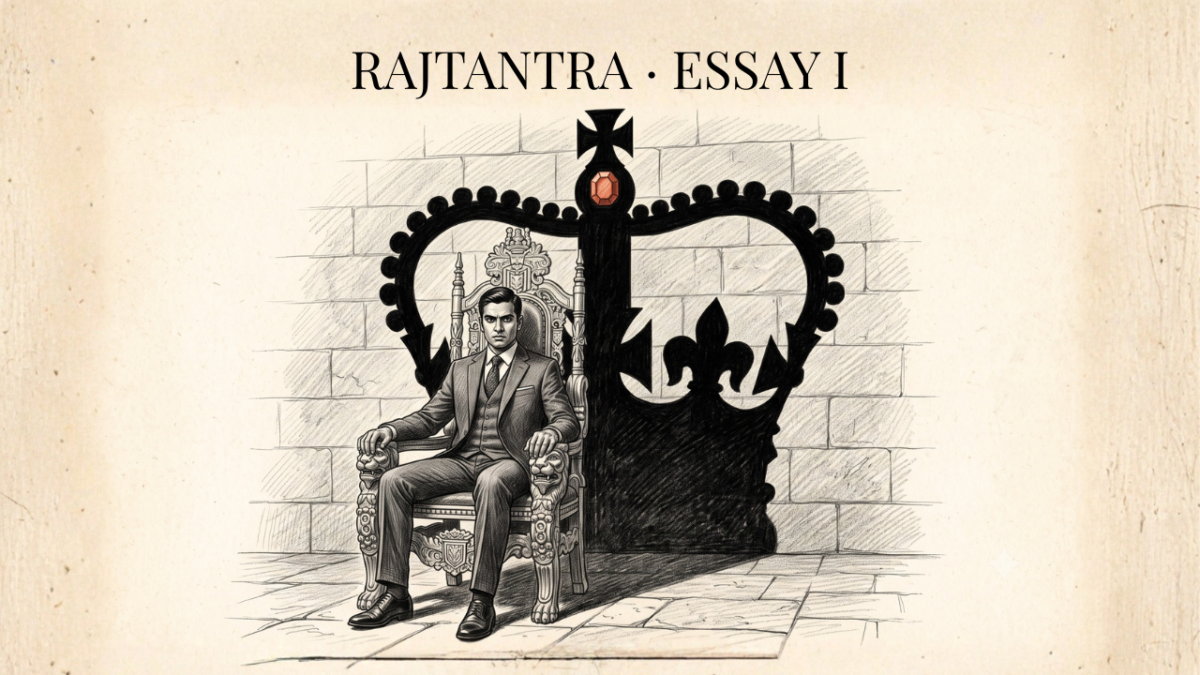
On the 2nd of February, 1835, Thomas Babington Macaulay presented his infamous Minute on Indian Education, arguing for the creation of “a class of persons, Indian in blood and colour, but English in taste, in opinions, in morals, and in intellect.” This class was not meant to serve India. It was meant to serve the Empire: a layer of interpreters standing between the British rulers and the millions they governed. The education system built on this Minute fed directly into the administrative machinery of the Raj, and that machinery, in its essential architecture, still governs Bharat today.
Consider the very title of the officer who heads a district: the Collector. The office was created by Warren Hastings in 1772, and the name was no accident. The Collector’s primary duty was to collect land revenue for the East India Company. Everything else, including magisterial and law-and-order functions, was bolted onto this core extractive purpose. That an independent republic, nearly eight decades after freedom, still calls its most visible administrator by a name that literally describes revenue extraction for a foreign trading company tells us how little we have interrogated the DNA of our institutions.
The economic story gives this more than symbolic weight. The economic historian Angus Maddison’s celebrated estimates show that around 1700, before British power took hold, the Indian subcontinent accounted for roughly a quarter of the world’s GDP, about 24 per cent, the largest economy on earth alongside China. By 1950, three years after the British left, that share had collapsed to around 4 per cent. Economist Utsa Patnaik has estimated that Britain drained wealth worth nearly 45 trillion dollars in today’s terms from India between 1765 and 1938. Dadabhai Naoroji called it the “drain of wealth” as early as the 1860s. And the instrument through which this drain was administered, district by district, famine by famine, was the civil service: the Indian Civil Service, which Lloyd George proudly called the “steel frame” of British rule in 1922. The ICS officer was trained to be efficient, incorruptible in small things, and utterly loyal to the extractive logic of Empire. He toured his district on horseback, received petitions, and dispensed decisions from a bungalow deliberately built at a distance from the native town. Detachment was not a flaw of the system. It was the design.
The GDP figures come from Angus Maddison’s The World Economy: A Millennial Perspective (OECD, 2001); Utsa Patnaik’s 45 trillion dollar drain estimate appears in Agrarian and Other Histories (2017).
What Independence Changed
What changed after 1947? Less than we like to believe. Sardar Patel, in the Constituent Assembly in October 1949, defended the continuation of the all-India services, arguing that the new nation needed the steel frame for unity and stability. The ICS became the IAS; the Imperial Police became the IPS. The Constitution, through Article 311, gave civil servants extraordinary protections against dismissal, protections stronger than those in almost any democracy. Training moved to the National Academy of Administration, established in Mussoorie in 1959 and later named after Lal Bahadur Shastri. The recruitment examination was opened up, and over the decades the service has genuinely democratised in its social composition. Officers now come from small towns, farming families, and every corner of the country, a far cry from the Anglicised elite of old.
Reform commissions came and went. The first Administrative Reforms Commission of 1966 and the second ARC of 2005 produced thoughtful reports on citizen-centric administration, most of which gathered dust. More recently, there have been real if incremental moves: lateral entry of domain experts into the government since 2018, the 360-degree appraisal system for empanelment, and Mission Karmayogi, launched in 2020, which explicitly aims to shift training from “rule-based” to “role-based” administration and to build a civil service rooted in Indian ethos. The replacement of the Indian Penal Code of 1860, the Criminal Procedure Code, and the Evidence Act of 1872 with the Bharatiya Nyaya Sanhita and its companion codes in 2024 was, whatever one makes of the details, the first serious attempt to decolonise the legal skeleton of the state.
Yet the lived experience of the ordinary citizen at the tehsil office, the police station, or the district court suggests the mindset has outlasted the manuals. The officer remains “saheb”; the citizen remains a supplicant. The generalist administrator still presides over specialists. The police still function largely under the framework of the Police Act of 1861, a law drafted in the shadow of 1857 to control a subject population, not to serve a free one. The Supreme Court’s directives in Prakash Singh (2006) for police reform remain half-implemented across states. The judiciary, with its colonial procedures and vocabulary, sits on a backlog of nearly five crore cases, making justice an endurance test rather than a right.
Stability Is Not Enough
And here we must be honest about the paradox. In a democracy where governments change every five years and political parties pull policy in different directions, it is precisely this permanent bureaucracy that provides continuity. It conducted elections, integrated princely states, ran famine-free food distribution, and held the administrative fabric together through wars and emergencies. The steel frame has kept the house standing.
A frame designed to hold a colony together is not the same as a frame designed to lift a nation up.
Stability without responsiveness becomes stagnation; the same structure that prevents chaos also slows transformation.
The task before us, then, is not demolition but reinvention. Rename the Collector as the District Development Officer if the word matters. But more importantly, redesign incentives so that an officer’s career rises with citizen outcomes, not with seniority and safe files. Strip the police of the 1861 mentality and give them the professionalism of a service, not the swagger of a constabulary. Simplify judicial procedure so the poorest litigant is not crushed by process. The British built a system where the people existed for the state. Amrit Kaal demands the inversion Gandhi asked for: a state that exists for the people. The steel frame need not be melted down. It needs to be reforged.
In today’s world everybody may he be politician or buerocrat is collector. The essence of Parliamentary democracy-Accountability is lacking altogether.Steel frame need not to be melted. down it has itself changed to bamboo structure bending according to the demand of their political masters.The concept-Generalist presiding over the Specialist and provision of Article 311 should be taken care of before thinking of any reform.
Beautifully put, “steel toward the citizen, bamboo toward the master.” This needs its own essay. In a democratic setup where political masters keep changing, it is the bureaucratic setup that carries the continuity.
Our leaders are the people’s representatives, and in a democracy, the people are the king, but that realisation is missing on both sides. So leaders act like kings, and of course, kings must have their courtiers. Maybe the rot runs deeper still. Democracy came to us as a constitution, but its meaning has yet to fully sink into the people. Till the citizen realises he is the king, the leaders will play king, and the courtiers will bend. That, perhaps, is the real essay waiting to be written.
A well-written article, and I agree that corruption, red tape, and a sense of entitlement within sections of the bureaucracy deserve criticism. However, I would hesitate to paint the entire institution with the same brush. In a democracy, Parliament and the political executive frame policy, but it is the bureaucracy that translates those policies into governance on the ground.
The challenge, therefore, is not to weaken the bureaucracy, but to reform it—making it more accountable, efficient, and citizen-centric while preserving its institutional strength.
A strong democracy needs both visionary policymaking and a competent, ethical bureaucracy.
You are absolutely right, Atul, and that’s exactly the point this essay puts forth- The Indian Bureaucracy is the steel frame which provides stability, and so, “The steel frame need not be melted down. It needs to be reforged”