
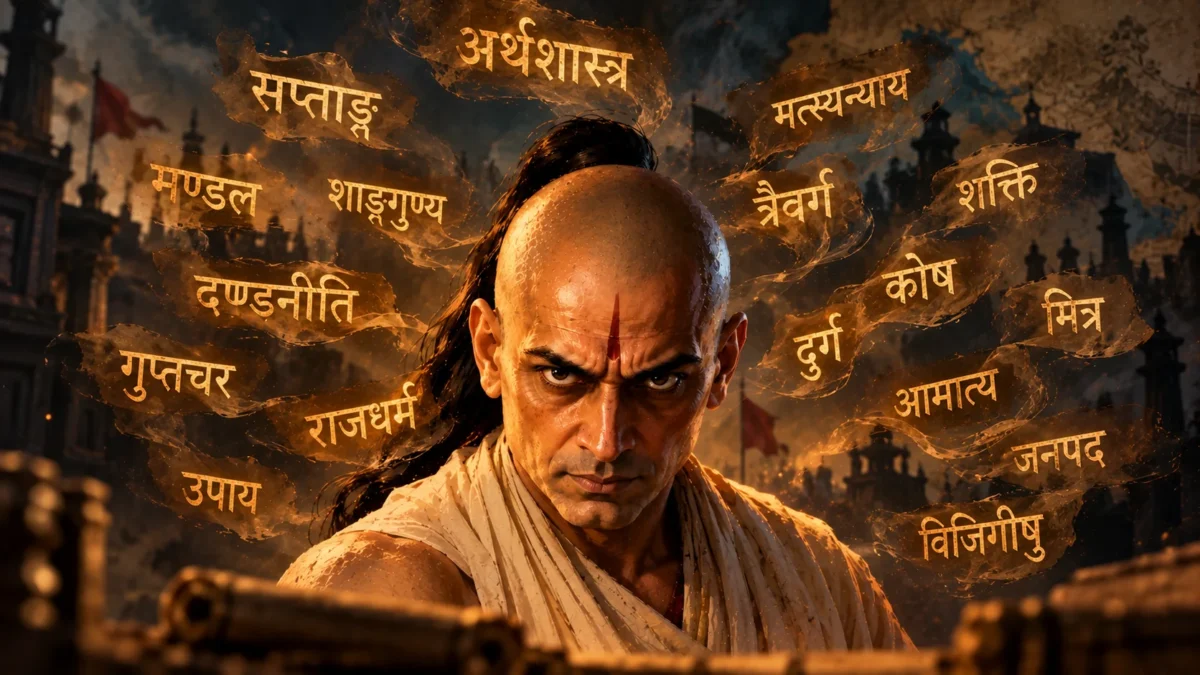
In 1905, a man from the Tanjore country walked into the Oriental Library at Mysore and handed over a bundle of palm leaves. They were inscribed in an old Grantha script, brittle with age, easy to mistake for one more fragment of forgotten Sanskrit. The librarian who received them, a scholar named R. Shamasastry, began to read, and slowly realised what lay in his hands. It was the Arthashastra of Kautilya.
For centuries the book had existed only as a rumour. Later writers, Dandin, Bana, Vishnusharma, had quoted it, alluded to it, built upon it; the Greek ambassador Megasthenes had described a Mauryan administration that matched its design. Scholars knew such a treatise had once existed. But the text itself had vanished, surviving only in these echoes, until the palm leaves surfaced in Mysore. Shamasastry published the Sanskrit in 1909 and an English translation in 1915, and the effect was immediate: here was proof, in India’s own hand, that the subcontinent had possessed a complete and ruthless science of statecraft long before Europe arrived to teach it one.
In a land where Bakhtiyar Khilji and his ilk showed their regard for scholarship by burning Nalanda and Vikramashila, the wonder is not that a book went missing, but that any survived.
The man who had written it lived some twenty-three centuries ago. His name was Chanakya, also called Kautilya, also Vishnugupta, and what he set down in that recovered text is one of the most remarkable works of political thought the human mind has produced. The German sociologist Max Weber, no admirer of cruelty, observed that beside the Arthashastra, Machiavelli’s The Prince reads as harmless. What is striking, though, is not merely its age or its hardness but how modern it feels. The state treated as a system with working parts. Economics as the foundation of power. Foreign policy as a calculus of interest. Intelligence as a permanent organ of government. All of it argued and organised at a time when most of the world had not yet begun to think of government as a subject at all. This essay is an attempt to set down, plainly, what this one man gave to the world.
The idea that the state is a thing that can be designed
We are so used to the nation-state that we forget someone had to imagine it. Chanakya’s first and perhaps deepest contribution was to treat the state not as the person of a king, nor as a gift of the gods, but as an organism: a structure with parts, each of which could be studied, strengthened, or allowed to decay.
He called this the Saptanga theory, the seven limbs of the state. The Swamin, the ruler. The Amatya, the ministers and the administrative mind. The Janapada, the territory and its people. The Durga, the fortified capital. The Kosha, the treasury. The Danda, the army and the force of law. And the Mitra, the ally. A state, in this view, was only as strong as its weakest limb, and the art of governance was the art of keeping all seven in balance. One can read this today as an early theory of what actually constitutes a functioning nation, the same elements a political scientist would list, named and ordered before the Common Era had properly begun.
The science of wealth
The very title of his work tells us where he placed the foundation of power. Arthashastra means, roughly, the science of artha: of material well-being, of wealth, of the practical means by which a society sustains itself. Chanakya did not regard the economy as beneath the dignity of a philosopher. He regarded it as the ground on which everything else stood. From the treasury, he wrote, comes the power of the government. A ruler without a full treasury was a ruler without an army, without roads, without the capacity to relieve a famine or deter an enemy.
And so the Arthashastra reads, in long stretches, like a manual of economic administration astonishing in its detail: on taxation and its limits, on the regulation of trade and weights and measures, on state ownership of mines and forests, on wages, on the duties of the superintendents of agriculture and commerce, on the prevention of fraud. He argued that taxes should be taken as the bee takes nectar from a flower, gently, without destroying the source. A ruler who impoverished his people, he understood, impoverished himself. Two thousand years before modern economics gave these ideas their vocabulary, Chanakya had grasped that a prosperous populace is the true wealth of a state.
Foreign policy as a system: the Mandala
Perhaps his most quietly influential idea is one the whole world still uses, usually without knowing its author. The axiom that the enemy of my enemy is my friend is, in its systematic form, Chanakya’s Rajamandala, the circle of kings.
Picture a state at the centre of a circle. The kingdom that shares its border is, by the logic of proximity and ambition, its natural rival. But the kingdom that lies beyond that rival, pressing on the rival’s far side, is its natural ally. And so it continues, ring upon ring: enemy, then friend, then enemy again, radiating outward across the known world. It is a map drawn not in geography but in interest.
From this he derived the Shadgunya, the six measures of foreign policy: peace, war, neutrality, preparation, alliance, and the double policy of making peace with one while waging war on another. What Chanakya was doing here has no real equal in the ancient world. Other thinkers advised rulers on how to handle a neighbour. He was describing the whole field at once, a system of many independent states in permanent, calculable relation to one another. It is, in the truest sense, an early theory of international relations, and it was written when the discipline that would eventually name itself after these questions was two thousand years from being born.
The intelligence state
Chanakya understood that a ruler who cannot see is a ruler who will fall. He therefore built into his science of the state a complete doctrine of espionage, and here it is worth being precise about what is original. The ancient world knew the use of spies, but it knew them as an instrument of war, a thing a general reaches for in a campaign. Chanakya was not writing for a general. He was writing for a state, and in his hands intelligence becomes a permanent organ of government, functioning in peacetime, turned inward on his own officials as much as outward at his enemies. That shift, from a tactic of war to a department of state, is his own.
The Arthashastra devotes whole chapters to it. He classified agents into the stationary and the wandering, and prescribed the disguises under which they should work: the false ascetic, the merchant, the householder, the recluse, the mendicant. He called this hidden network the gudhapurusha, the secret men. They were to be placed in the courts of allies and enemies alike, to gather intelligence, to test the loyalty of the king’s own officials, and to shape events from the shadows. He grasped, too, the uses and the dangers of what a later age would call the honey trap, deploying it against others and warning his own agents to expect it in return. In this, the Arthashastra is less a book of philosophy than the founding document of the intelligence state.
Power with a conscience
It would be easy, reading only of spies and statecraft, to cast Chanakya as a cold and amoral schemer. He was certainly a realist, and an unsentimental one: the text does not flinch from force, from deception, or from the hard arithmetic of survival between hostile neighbours. But realism was never the whole of his teaching, and this is where he is most worth recovering.
For all his clear sight, Chanakya placed the ruler under a firm moral obligation to the welfare of the governed. His most famous line on kingship is not about conquest but about care: in the happiness of his subjects lies the king’s happiness, in their welfare his welfare; the king shall not consider as good only what pleases him, but treat as beneficial whatever pleases his subjects. The king, in this vision, is not the owner of the state but its servant, a trustee bound by duty, whose own interest is inseparable from the flourishing of his people.
This is realism, but it is moral realism, and it is precisely the element that the European manuals of power, when they arrived two thousand years later, would quietly discard. The power Chanakya describes is not power for its own sake. It is power harnessed to dharma: to right order, to obligation, to a rule that justifies itself by its service.
He permitted a king almost anything except the one thing that mattered, which was to forget whom the kingdom was for.
The question that remains
It is easy to admire a thinker and quietly file him away as a theorist, a man of the study whose ideas were never tested against the weight of the world. Chanakya allows no such comfort. He took an obscure youth and placed him on a throne, broke a dynasty, and stood up an empire that reached from the northwest mountains to the edge of the Tamil country, and he did it all without ever sitting on that throne himself. The book is not speculation; it is a record of what worked, written by the man it worked for.
The Arthashastra runs to fifteen books and a hundred and fifty chapters, covering a hundred and eighty distinct topics of government.
Which leaves one question, and it is not a question about the past. Chanakya was not an accident. He was produced by something: by the university at Takshashila, by a culture that funded teachers, argued in public, and expected a scholar to know how the world actually worked. The question for Bharat today is not whether we can admire him. It is whether our schools, our universities and our public life are building the kind of place that could produce him again. We have recovered his book. The harder thing is to recover the soil he grew in.
Write your response