
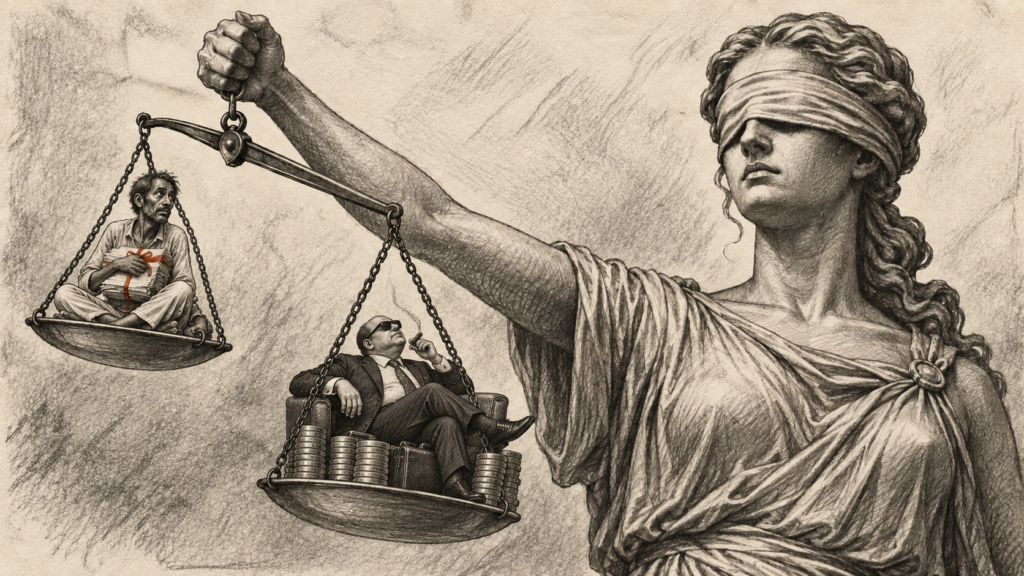
There is a particular kind of Indian morning that deserves to be studied. A man wakes at four in his village, takes a bus to the district town, reaches the court by nine, and finds his matter listed at serial number 68 of a cause list of 90. He waits on a stone bench outside the courtroom for six hours, holding a file he cannot read. At four in the afternoon a clerk calls his number, the words “next date” are spoken, and he takes the bus home. He has lost a day’s wages. He has gained a date. He will do this again in eleven weeks, and again, and again, until the case outlives the quarrel that started it, or outlives him.
Somewhere in the same city, on the same morning, another matter is heard for forty minutes by a bench that had allotted it ten, because the counsel arguing it charges in a day what our man on the bench earns in five years, and everyone in that courtroom, including the bench, knows his face.
Both of these things are our justice system. The distance between them is the subject of this essay.
Everyone quotes the number and nobody feels it: more than five crore cases pending across Indian courts, some four and a half crore of them in the district judiciary alone. Figures of that size stop meaning anything; they become weather. So let us set pendency aside as a mere symptom and name the disease. Our courts have no functioning relationship with time, and almost no relationship at all with the people who need them most.
Justice, and the Price of a Face
For the rich, the Indian legal system works tolerably well. Money buys the senior advocate whose arrival changes the temperature of a courtroom, and power buys the patience to wait out any adversary. It is the poor litigant, the small shopkeeper, the widow fighting over a strip of land, who discovers that the law is theoretically his and practically somebody else’s.
What has crept in is difficult to name precisely. It is not nepotism in the dictionary sense, though the dynasties in our Bar and Bench make the word tempting. Call it the tyranny of face value. Fees of several lakhs, sometimes crores, are paid not for a superior reading of the law but for recognition: for a name the bench knows, a presence the registry accommodates, a voice that gets a hearing when ninety others are waiting. The argument is supposed to be the currency of a courtroom. Increasingly it is the arguer.
It is tempting to dismiss this as the grumbling of litigants who lost. It isn’t. Three law professors went looking for the evidence and published it in a book called Court on Trial. One of its chapters is titled, with no need for euphemism, “Face Value.” They found that petitions argued by senior advocates clear the Supreme Court’s initial hearing about 35 per cent of the time, against 28 per cent for everyone else. The obvious defence is that senior advocates simply bring better cases. The data says otherwise: at the final hearing, cases argued by senior advocates win slightly less often, 57 per cent against 60. So the advantage is not in the merits. It is in the face.
Court on Trial: A Data-Driven Account of the Supreme Court of India, by Aparna Chandra, Sital Kalantry and William H.J. Hubbard (2023).
But every litigant in India senses it, and a system that the poor believe is purchasable has already lost something that no rate of disposal can restore.
The Adjournment Culture
Now to the mechanics of the wasted morning, because delay is not an accident of workload. It is a habit, and like most habits it is defended by everyone who benefits from it.
The chief instrument is the adjournment, sought and granted as routine. The extraordinary thing is that the law already forbids this. Order XVII of the Civil Procedure Code, as amended in 2002, permits no party more than three adjournments during the hearing of a suit. The rule is unambiguous, it has stood for over two decades, and it is ignored so completely that most litigants have never heard of it.
So what India needs here is not a new law but a spine. Two opportunities to file a reply, and after that the right is closed or the costs are heavy enough to be felt. And one refinement matters more than the rest: when the delay is caused by counsel rather than the client, the penalty must fall on the lawyer. Today the man on the stone bench, who controls nothing, pays for every date with his wages, while the person who asked for the date pays nothing at all. Fix that inversion and you have done more for Indian justice than a hundred new courtrooms would.
The cause list needs the same discipline. High Courts routinely list far more matters than any bench can hear, knowing that one long argument will swallow the day. The result is a daily lottery in which hundreds travel, wait and go home unheard. Hospitals give appointments. Airlines give slots. Only our courts still summon ninety people to be told to come back.
The Empty Bench and the Long Holiday
None of this is possible without judges, and India has not bothered to have enough of them. The entire justice system of 140 crore people runs on roughly 21,000 judges. The Law Commission recommended fifty judges per million citizens; we manage about fifteen. Nearly a fifth of sanctioned district court posts lie vacant, and High Court vacancies hover near a third, with appointments stalling for months in the slow correspondence between the collegium and the government. A vacant court is a court where nothing happens to anybody, and we tolerate these vacancies as though a judgeship were a decorative post.
And then, with crores of cases waiting and a third of the benches empty, the institution closes. The Supreme Court sits for around 190 days in a year, the High Courts for roughly 210, against the 245 or so worked by trial courts and by every other Indian who works for a living. The recent renaming of vacations as “partial court working days” is an admission that the criticism has landed, but an admission is not a reform. One may argue that judges need time to read and write judgments, and that is true. It is not an argument for the courthouse being dark for a hundred days while a man’s bail application ages.
Who Checks the Checker?
Here is the fact that ought to end every argument about judicial accountability in this country. In the entire history of the Republic, not one judge has ever been impeached. Not one. Proceedings were begun twice and collapsed both times, once when Parliament’s numbers failed and once when the judge resigned before the vote.
Now ask yourself the only honest question available. Is the Indian judiciary composed of eighty years of faultless men and women, or is it an institution whose faults have nowhere to go? Everybody has heard the talk about what happens in the lower courts. Fewer people know what happens higher up, and those who know are rarely those who tell. The point is not to accuse anyone. The point is that a democracy built on checks and balances has one institution nobody checks. The legislature was meant to. That check is now a ceremonial object.
This unaccountability has a manner, and the manner is inherited. Our advocates still say “Your Lordship” in a republic that abolished lordships for itself, and the Bar Council of India resolved as long ago as 2006 that “Your Honour” or plain “Sir” would do. Twenty years on, the lords remain, because deference outlives the rules that retire it. Perhaps it is only semantics. But the lords we remember are Curzon and Mountbatten, and a free people should be careful about the words it keeps using for the people who judge it.
A politician, whatever his sins, must return to his voters every five years. To whom does a judge return?
None of this is a case against the judiciary. It is the institution Indians still trust more than any other, and that trust is precisely the asset being spent. Fill the benches, meter the adjournments, open the courts for more of the year, take the price off the face, and build a credible way to examine a judge that does not depend on a parliamentary miracle. A society can survive poverty and it can survive disorder. It cannot survive for very long in the settled belief that justice is something other people can afford.
Write your response