
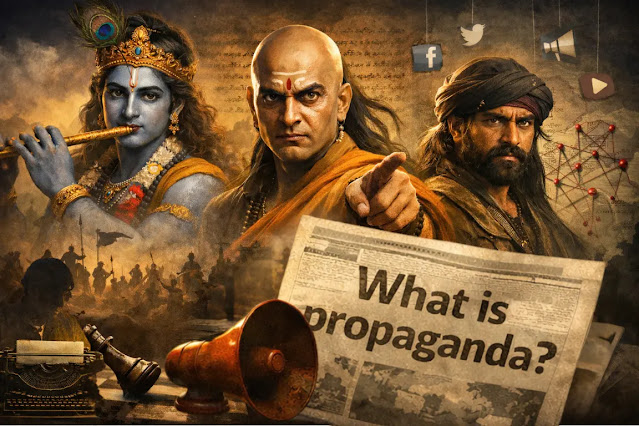
The recently released movie Dhurandhar has once again ignited a war of words in the social sphere. People seem sharply divided; some question its authenticity, others dismiss it as a propaganda piece. This debate raises a set of very valid questions: What exactly is propaganda? How do we identify it? Is there such a thing as propaganda-free art? And finally, does it even matter if a creative work contains propaganda, or is it more important to examine what kind of propaganda it is?
Propaganda, at its core, is information presented in a biased or selective manner to influence what people think, believe, or do. By that definition, propaganda is not inherently malicious. When a mother creates a simplified or exaggerated story to persuade her child to eat vegetables, she is, in effect, engaging in propaganda to ensure her child’s well-being. The intent matters.
Propaganda exists because societies do not operate in a vacuum of pure rationality. You cannot simply place bare facts in front of people and expect them to arrive at neutral conclusions, free from personal bias or social conditioning. Ideally, clarity, the ability to see reality as it is without inherited lenses shaped by community, culture, or ideology, would eliminate the need for propaganda altogether. But that ideal world does not yet exist. Until then, propaganda remains a tool, one that can be used to further a shared social objective.
The Pandavas could not have won the war without the strategic use of propaganda by Sri Krishna at multiple levels. When Krishna urged Yudhishthira to speak a partial truth to Dronacharya regarding Ashwatthama’s death, it was an act of narrative manipulation. The same applies to the psychological warfare surrounding Jayadratha’s death or the sustained mental pressure placed upon Karna. These were not random acts of deception but calculated interventions designed to achieve a specific outcome. Propaganda, in this sense, was neither moral nor immoral; it was instrumental. Its ethical weight depends entirely on who uses it, how it is used, and toward what end.
This question becomes far more urgent in modern times, where social media and digital communication dominate public life. Propaganda is no longer the exclusive domain of powerful states or institutions. Technology has introduced multiple points of corruption into the process of narrative-building. Historically, gossip has always held more sway than truth. Very few people ever know the complete truth; most operate on fragments, rumours, and second-hand accounts. Social media is essentially gossip amplified to a global scale. Anyone, anywhere, can influence public discourse, depending on the resources at their disposal. When something trends, it becomes almost impossible to determine whether it represents genuine public sentiment or a coordinated propaganda effort. More often than not, what appears organic is actually targeted narrative management, what we now casually call PR.
Given these complexities, it becomes essential for a society or a nation to establish its own narrative before external forces impose one upon it. Narrative-building today is arguably more powerful than nuclear weaponry. Nuclear weapons exist, but their use is constrained; narratives, on the other hand, can be deployed continuously, subtly, and with devastating long-term consequences. History offers numerous examples of how narrative warfare has been used to destabilise and topple governments across the world.
Narrative-building today is arguably more powerful than nuclear weaponry.
As I write this article, the United States is invading Venezuela and has reportedly taken its president hostage, acting with complete impunity. It is safe to assume that Donald Trump’s hopes of a Nobel Peace Prize can now be laid to rest; though, in many ways, even that prize functions as a sophisticated tool of propaganda. It is therefore unsurprising that Trump’s actions enjoy the full support of Venezuela’s Nobel Prize winner. And also remember who rushed to the rescue of Bangladesh when its democratically elected leader was removed following a popular protest? Once again, a Nobel Prize winner. Which raises an uncomfortable question: are these Nobel laureates champions of peace, or merely vassals of vested interests?
Secret agents shall circulate false reports of disaffection, calamity, and divine displeasure in the enemy’s territory.
Chanakya, The Arthashastra
“Secret agents shall circulate false reports of disaffection, calamity, and divine displeasure in the enemy’s territory,” Chanakya wrote over two thousand years ago in The Arthashastra, laying out the mechanics of narrative warfare. The tools have changed since then, but the principle remains intact. Today, there are no secret agents in disguises; there are timelines, trending hashtags, and carefully worded opinions dressed up as concern, analysis, or common sense. And that brings us to an uncomfortable but necessary pause. If propaganda is simply the strategic framing of reality to push a particular conclusion, then perhaps this article, too, is doing exactly that. Or is it?
Excellent
Extremely well written
Excellent written article, if possible pl write social articles like as drugs, divorce , etc