
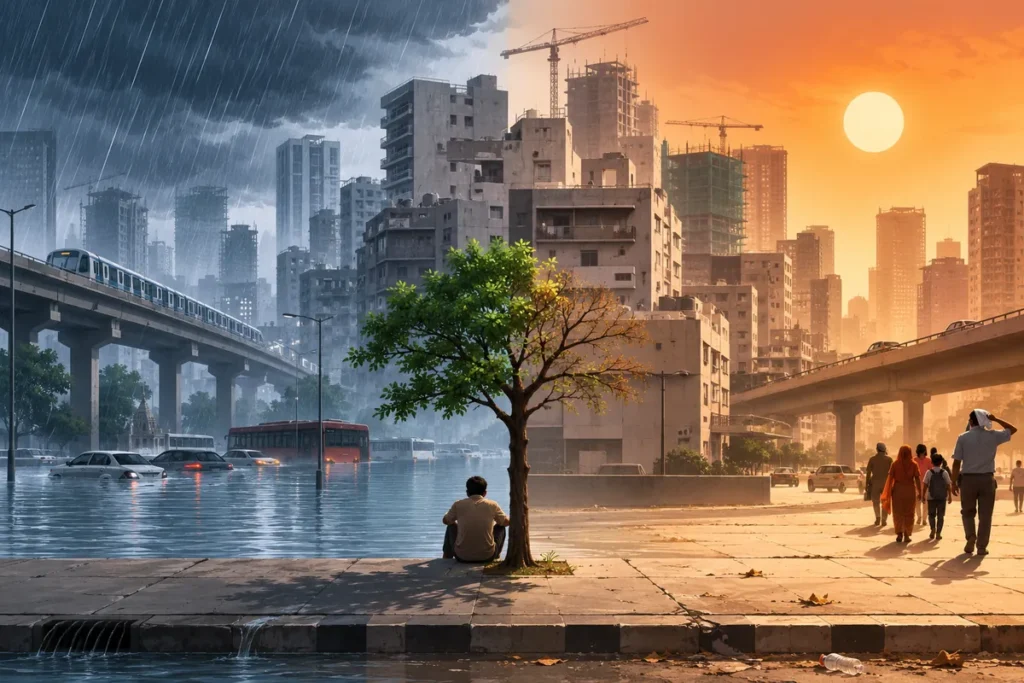
Drive through any Indian city today and one thing becomes impossible to miss: cement. Jahan dekho wahin cement daal dete hai. Footpaths, courtyards, road shoulders, park pathways, even the little patch of soil around a tree, all encased in grey. There is a genuine national appetite for building, and much of it is overdue. India needed roads, flyovers, metros, drains, and housing at a scale few countries have ever attempted in so short a time. Yet the manner in which we are building, hurried, uncoordinated, and almost pathologically fond of concrete, is quietly setting up our cities to fail, especially when the monsoon arrives.
The problem announces itself every June. India is a monsoon country. Bharat’s civilisational calendar, its agriculture, its music, its poetry, all of it is organised around a season when the sky opens up. But the “modern” city we are building has no relationship with rain except one of panic. Water that used to soak into soil, feed lakes, and recharge aquifers now hits an unbroken skin of concrete and immediately becomes a problem to be flushed away. Drains designed for rainfall intensities of 12 to 20 mm per hour are being asked to swallow bursts of 50 to 100 mm per hour, and they simply cannot. The result is the now-familiar montage: Bengaluru’s tech parks turned into islands, Mumbai locals suspended, Delhi’s Minto Bridge underpass flooded on cue, Chennai’s arterial roads submerged, cars floating in Gurugram basements.
The scale of the paving is genuinely startling. An IISc study found that between 1973 and 2023, Bengaluru’s paved surface grew by more than 1,000 per cent, while its water bodies shrank by 79 per cent and its vegetation cover by 88 per cent. Chennai’s Pallikaranai marsh, once stretching across roughly 5,000 hectares of natural sponge, has been reduced to about one-tenth of its original size, largely swallowed by real estate and landfill. When the 2015 floods hit Chennai, leaving 280 people dead, the trigger was the encroachment of lakes and riverbeds. The water was not behaving abnormally; the city had simply built over the places where water had always gone. The NDMA estimates that urban floods now claim around 500 lives in India every year, and the number keeps trending up.
There is a cruel absurdity in the picture. On one hand, we cement over every square metre so that rainwater cannot enter the ground. On the other, we watch groundwater tables fall so fast that Bengaluru already meets 45 per cent of its water demand from borewells that are steadily drying out.
We flood in July and run dry in April, in the same city, because we have engineered both outcomes.
More than 80 per cent of the roughly 20 tmcft of rainwater that falls on Bengaluru every year is wasted as runoff simply because there is nowhere for it to soak in.
Then the Oven
And then comes the summer, when the same cement extracts a second price. Concrete and asphalt are efficient sponges, not for water, but for heat. They soak up solar radiation through the day and release it slowly through the night, which is why Indian cities now stay uncomfortably warm long after the sun has set. Studies estimate that decades of urban expansion have intensified the heat-island effect in parts of Delhi by 5 to 6°C, and the Indian Institute of Tropical Meteorology has mapped at least 60 heat islands across the capital, most of them in dense residential and commercial zones. When Delhi touched 47.3°C on 27 May 2024, one of the highest ever recorded in the city, that was not just climate change at work. That was a city engineered to trap heat, stripped of the trees, water bodies and shaded ground that would otherwise release it. The World Resources Institute counts over 6,100 heat-related deaths in India since 2010, and the burden falls hardest on the poor: an air-conditioned tower manages, but a tin-roofed basti with unplastered brick walls becomes literally an oven by afternoon.
Another Kind of City
The alternative is not exotic. It is called planning. Sponge-city principles, such as permeable pavements instead of solid concrete, rain gardens along road medians, protected wetlands and lakes acting as natural buffers, and drainage designed for 21st-century rainfall bursts, are not futuristic. Over 30 Chinese cities have adopted these principles; Wuhan now manages 70 per cent of its rainwater through green rooftops, permeable pavements and water storage systems. Amaravati is being designed with green corridors, revived water bodies and permeable pavements, and Bengaluru has begun restoring lakes such as Kaikondrahalli. These are small proofs that another kind of city is possible.
We are in a rare window. Most of the India of 2050 has not been built yet. Every kilometre of road, every colony, every industrial park being poured today is a fifty-year decision. The choice is simple but urgent. Keep pouring cement wherever the eye lands and rebuild after every monsoon and bake through every summer, or pause, coordinate, and build cities that can breathe with the rain and cool themselves in the heat instead of drowning and burning by turn. The concrete itself is not the villain. The mindset that reaches for it before it reaches for a plan, is.
bruh, i get the point, but india is insanely densely populated, especially in metro cities. you can’t realistically expect places like Mumbai, Delhi or Bengaluru to suddenly become “sponge cities” with huge amounts of open soil, wetlands and greenery everywhere. people need housing, roads, metro lines, parking, offices etc, and land in these cities is already ridiculously expensive.
capitalism also means developers and governments are obviously going to prioritize what gives them the most immediate return. so yeah, better planning and permeable surfaces are good ideas, but acting like we can just replace concrete everywhere isn’t realistic. the real challenge is figuring out how to make dense cities more water- and heat-resilient without pretending density itself can disappear.
Also stop using clanker voice
Read the Essay one more time, and you can read if you did not like the voice.
Very well written piece as always, there is hope. I definitely feel like we need to bring together planners, architects, climate experts and people who are most vulnerable to work out how planning needs to be done in the cities. The priority cannot be capitalist profit in the development of a city, it has to be the needs and safety of the people who dwell in them. This article provides a glimpse into what is possible.
Thank you, Surkhraj