Every nation tells a story about where it begins. Most begin with a treaty, a war, a line agreed upon by men in a room. Bharat begins differently — not with a boundary, but with a question asked at the edge of the Himalaya and carried south, again and again, by those who walked toward the rivers.
The word itself is older than any state that has claimed it. It belonged first to a people, then to a land, and only much later to a map. The sequence matters: a civilisation that names itself before it draws its borders is telling us that it understands identity as something carried, not something enclosed.
A Continuity, Not a Monument
It is tempting to read the past as a sequence of ruins — to treat whatever survives as evidence of what has ended. The more difficult reading, and the more honest one, is that remarkably little here has truly ended. The chant heard at a river this morning is not a reconstruction; it is the same chant, in an unbroken line, that someone offered at the same bend three thousand years ago.
This is what makes Bharat difficult to translate into the vocabulary of the modern nation. A nation is an arrangement; a civilisation is an inheritance. One can be founded in an afternoon. The other can only be remembered.
A civilisation that names itself before it draws its borders understands identity as something carried, not enclosed.
The Many Maps
Open any atlas of the past and you will find not one Bharat but a hundred. The Mauryas drew it one way and the Guptas another; the Cholas pushed its edges into the sea while later sultanates redrew its north. The Mughals administered it in Persian and the Company in ledgers, and the Republic inherited a line settled, in the end, by a departing empire. Every ruler arrived with his surveyors and his seals, each certain that the map he held was the country. Each was wrong in the same way.
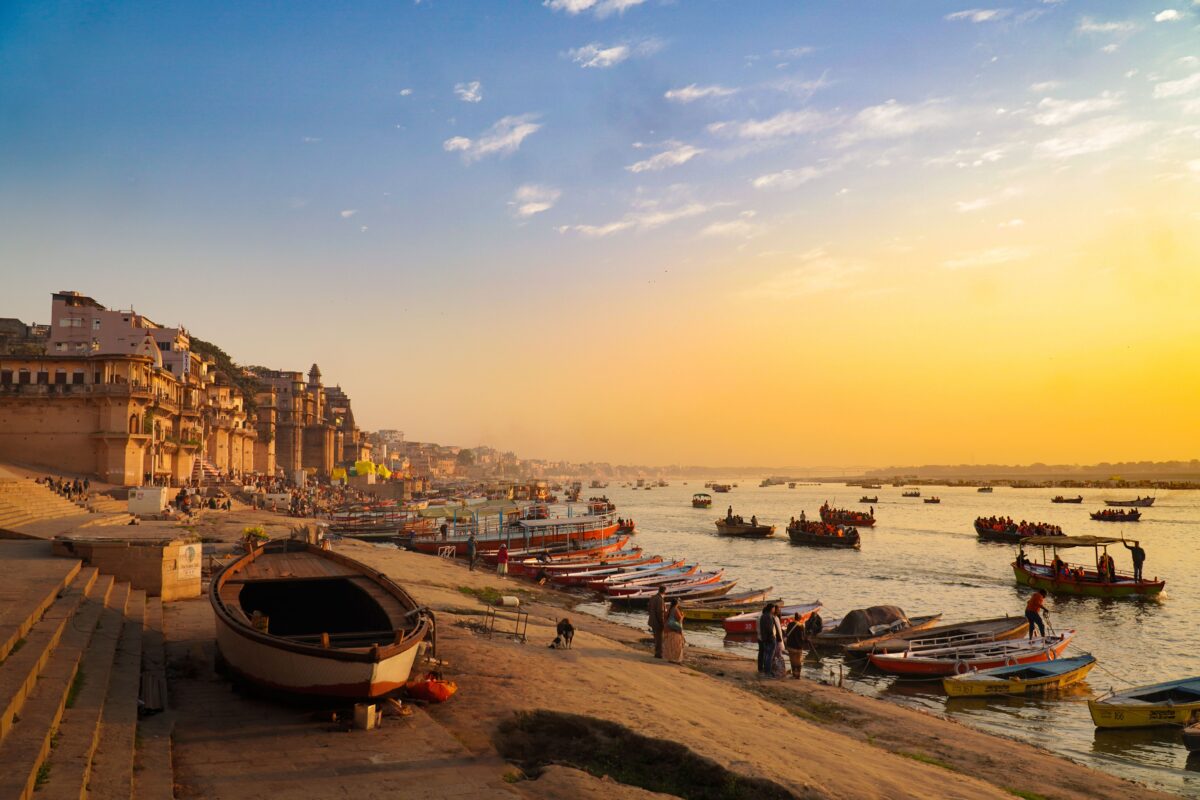
For beneath every one of those maps ran something the surveyors never charted. The pilgrim walking from Rameswaram to Kashi did not halt at any of these borders, because for him they did not exist. The chant did not change when the dynasty did. The rivers kept their names through every conquest. A thousand political maps have been drawn over this land and quietly erased; the older map — of tirthas and rivers, of a sacred geography held in memory rather than ink — was never redrawn, because no ruler had the authority to redraw it.
This is the paradox at the heart of Bharat. Its politics has changed ceaselessly; its identity has barely moved. Empires that looked permanent lasted a few centuries and vanished. The habit of walking to the same river to remember the same thing has outlasted all of them together. The maps were always provisional. The pilgrimage was not.
What the Rivers Knew
Geography here was never merely physical. The rivers were teachers before they were trade routes. To name the Ganga, the Yamuna, the vanished Saraswati was to name not water but witnesses — presences that had watched the long argument between forgetting and remembrance, and had always taken the side of memory.
To ask what Bharat is, then, is to ask the wrong question in the wrong tense. The better question is what Bharat remembers — and whether we, who have inherited that memory, intend to keep it.
In the Vishnu Purana, Bharata is named not as a kingdom but as the land “north of the seas and south of the snows” — defined by geography and devotion, never by decree.
We are indeed very ancient civilization, so ancient that our history has turned into mythology
nice article
Very much interesting topic about our Bharat.
Jay Hind. Jay Bharat.
Thank you for appreciating the effort
What a perspective…….. that’s one way to look at it.💯